
From Compliance to Accountability: Recent updates in the PoSH Landscape
For years, POSH has remained a statutory requirement, often reduced to a mere checklist. Implementing a POSH Policy, establishing an IC, conducting annual awareness sessions, and reporting these updates to authorities have been the basic indicators of an organisation being “compliant” and organisations have settled with doing the bare minimum,.
But the question stands: is compliance really only about ticking off all the boxes? Or is there a greater responsibility resting on the shoulders of every layer of the system to ensure that these mechanisms are implemented fairly when needed?
Recent developments in POSH have placed greater emphasis on the effective and fair implementation of existing mechanisms and laws established in India. Several institutions, including the National Commission for Women and State authorities, are actively working towards making Indian workplaces safer, more accountable, and better equipped to address sexual harassment.
The NCW Advisory
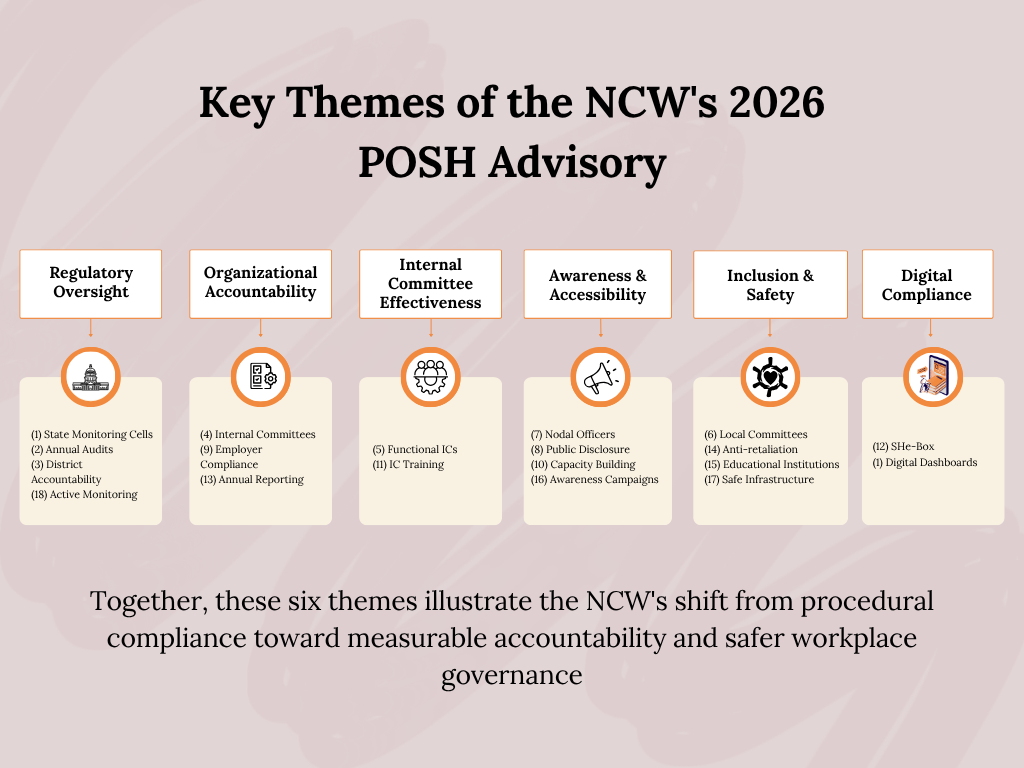
The National Commission for Women (NCW) has issued a nationwide advisory urging the mandatory implementation of POSH Audits and calling for the adoption of strong workplace safety mechanisms across India. It has primarily extended its recommendations to the States and Union Territories of India, broadly covering areas of Governance, Organisational Compliance, Internal Committee effectiveness, and awareness and accessibility. The advisory seeks to ensure that all workplaces strictly adhere to the provisions of the POSH Act and promote a gender-sensitive and secure environment for women. To accomplish this, it has released a set of 18 new measures which in fact collectively point towards a broader shift in how POSH compliance is expected to function.
On the topic, Smt. Vijaya Rahatkar, Chairperson of NCW said, "A woman should never have to choose between her dignity and her livelihood. Every workplace must be a space of safety, respect and equal opportunity. Effective implementation of the POSH Act is not merely a legal obligation but a collective responsibility towards ensuring women's empowerment and participation in nation-building."
This advisory makes one thing clear: POSH compliance cannot stop at having the proper mechanisms in place. It needs to focus on creating and sustaining an ecosystem wherein POSH mechanisms can be effectively implemented and continuously monitored. These mechanisms need to be readily accessible and must be framed in such a way that they can be easily understood.
The POSH Compliance Checklist
In May 2026, the Government of Maharashtra issued a circular containing a comprehensive POSH Compliance checklist as an enforcement-oriented approach to POSH. The circular aims to ensure effective implementation of POSH mechanisms in the rapidly expanding landscape of private establishments, government and semi-government bodies, corporations, and institutions operating across the State.
This brings us back to the point raised earlier: For organisations, in order to meet the threshold of POSH compliance, ticking off every box and reporting to authorities has traditionally been considered sufficient enough. The circular tackles this exact problem by treating the POSH mechanism as a holistic governance system, with greater focus on implementation.

The document opens up with addressing the laws and mechanisms already in effect, ranging from the Government's power to inspect organisations’ compliance to the constitution of ICs and local committees. The circular also provides a list of officers and sets out their respective responsibilities ranging from conducting and coordinating inspections to supervising the entire process and ensuring compliance with the prescribed checklist.
The checklist has 5 sections that focus on the following areas:
Part A: Compliance Related to POSH Policy and Internal Committee (IC)
This section discusses the formulation of a POSH Policy and its dissemination to all employees while also covering the constitution of ICs, including the number of members, their composition, and the appointment of a Presiding Officer and external member. Notably, it also calls for every office/unit to have a separate IC, instead of a centralised one.
Going beyond the existing legal requirements, the checklist requires establishments’ policies to include remote/ virtual work environments such as Work From Home. The SHe-Box portal link and policy also need to be made available on the organisation’s website and official social media channels.
Part B: Support / Assistance to the Aggrieved Woman
Part B of the notice focuses on the aggrieved woman and her well-being. The checklist contains points such as modes of communication, timely redressal of complaints, provision of interim relief, ensuring no retaliatory action is taken against the woman, and providing counselling and legal services if and when required.
Notably, the checklist shifts the approach to a POSH case from a basic complaint mechanism towards ensuring the safety and wellbeing of the aggrieved woman.
Part C: Awareness and Training
The checklist also requires organisations to train their Internal Committee members in handling complaints through regular training and workshops. It also enquires whether regular training programs are being conducted for employees.
Part D: Employer’s Responsibility
Part D extensively covers the employer’s responsibilities in a wide range of areas and addresses timelines for inquiries, proactive action on the IC report and recommendations, confidentiality of records, annual reporting and disciplinary actions in cases of proven misconduct.
This section places the responsibility for POSH compliance directly on the employer and makes it an ongoing monitoring exercise. The checklist also examines whether the organisation is ensuring a conducive workplace environment for all the employees. These requirements therefore put employers in the centre of maintaining a safe workplace.
Part E: SHe-Box (Sexual Harassment Electronic Box) Onboarding
This section examines the compliance relating to SHe-Box. It requires that organisations appoint a Nodal Officer and onboard their offices onto the portal. The organisation’s annual reports also need to be uploaded on a regular basis.
Overall, the 5 sections examine all aspects of a POSH mechanism from awareness to complaint handling, redressal and employer responsibility. The checklist connects everyone within the organisation including the employees, IC members, employers and designated authorities. This makes POSH a shared responsibility where each layer of the system works towards ensuring that POSH mechanisms remain accessible, responsive and effective.
Conclusion:
Taken together, these developments are evidently indicating a shift in the way POSH compliance is being approached in India. Though the underlying requirements outlined in the POSH Act stay the same, greater emphasis is now being placed on how effectively the mechanisms are being put to use when needed.

The NCW Advisory and the Maharashtra POSH Audit Checklist approach the same issue from two different angles. There is a significant overlap in the content and areas covered by both bodies, with both stressing the need for stronger IC mechanisms, awareness and accessibility. This overlap goes to show that recent developments are not isolated occurrences. Institutions are actively working towards bridging the gap between formal compliance and effective implementation.
The NCW Advisory serves as a reminder for States and Union Territories to establish a stronger POSH framework. It advocates for greater scrutiny of mechanisms that are already established under the law and advises authorities to ensure these systems are effectively implemented. The Advisory’s call for mandatory POSH Audits is particularly important as it will enable the government to regularly assess organisations and strengthen accountability.
The Maharashtra POSH Audit Checklist takes this a step further by introducing its organisation-wide inspection framework. It expands on the intention behind the POSH Act and examines whether the POSH mechanisms set in place are responsive and capable of providing support when needed. Though it serves as a checklist, its purpose goes beyond ensuring that statutory requirements are met.
The focus therefore shifts from answering whether a complaint mechanism exists to whether the organisation is well equipped to handle POSH situations effectively.
Both developments ultimately point towards the same objective: ensuring that POSH mechanisms do not remain limited to policies, committees and training sessions and instead focus on developing a responsive and accessible system of protection.
Written by: Syed Tatheer Raza Imam
References
https://ssrana.in/posh-law/articles/ncws-mandatory-posh-compliance-advisory-beyond-paper/
https://complykaro.com/ncw-mandatory-posh-audits/